
Vet disclaimer — read this first: This article is general information, not veterinary advice. Every weight figure in it comes from a named source, and where the sources disagree, the disagreement is shown rather than hidden — and for the Boxer, the disagreement is the widest of any breed in this series so far. Boxers are a late-filling muscular breed: a gangly adolescent that looks skinny is usually normal, but “looks thin” and “is underweight” are two different things, and this article separates them with a test you can do at home. If your Boxer puppy is far outside the ranges here, is losing weight, or stops eating or playing, take them to the vet at once. We did not weigh any puppies for this article, and it has no affiliate links.
Your Boxer puppy looks skinny. Not a little lean — properly skinny, all legs and ribs and chest, with a head that seems too big for the body underneath it and a coat stretched over a frame that has not filled in yet. You put it on the scale, and the number does not match anything you read online. One website says a 6-month-old male Boxer should weigh 43–53 lb. Another says 50–60 lb. A third says 22.7–38.3 lb — a range whose top end sits below the first chart’s bottom end. All three are describing the same breed at the same age, and they cannot all be right in the way a single number would be. Pick the wrong chart and you will either worry over a perfectly healthy puppy or miss the one that genuinely needs help. And with a Boxer, the worry has a specific shape: this is a breed whose standard prizes a square, muscular, working build — so a healthy Boxer puppy looks underweight to almost everyone who has only ever owned a stockier dog, and the filling-out does not finish until the dog is two or three years old.
This guide fixes the chart problem properly. First, a Boxer puppy weight chart by age built by reconciling the four sources that publish sex-split tables anchored on the AKC adult standard — with the two outliers (a modelled curve that runs far below everyone else, and a chart whose 12-month figure sits above its own adult range) shown rather than hidden. Then the disagreement behind the chart, stated openly: the 6-month spread, the 12-month spread, and the fact that even the adult anchor itself is disputed. Then the section no rival owns in this form — the “too skinny?” test that separates a normal gangly Boxer adolescent from one that genuinely needs a vet — a short male-versus-female note, worked examples using a published percentage method, the underweight and overweight red flags for a fast-growing large breed, and a weekly weighing routine that takes five minutes and a bathroom scale.
The short answer: An adult Boxer weighs 65–80 lb (29.5–36.3 kg) for a male and 50–65 lb (22.7–29.5 kg) for a female under the AKC breed profile — the figure four of the six sources in this article use, with two rivals publishing a heavier female range instead. An 8-week-old male should weigh roughly 9–20 lb, a female 7–16 lb — the widest 8-week spread in this series, because the sources disagree about how wide the range is, not just where it sits. Most Boxers reach their full height by about 12–14 months, their full weight by about 15–18 months, and keep filling out with chest and muscle until 2–3 years — so a lanky 10-month-old that looks half-finished usually is. And the number that worries owners most is the one this breed gets wrong most often: a healthy Boxer puppy is supposed to look lean. If you can feel the ribs under a thin fat layer, see a waist from above, and your puppy is gaining steadily and playing hard, it is almost certainly fine — the test that tells you otherwise is in its own section below.
Table of Contents
- Boxer Puppy Weight Chart by Age
- Why Boxer Weight Charts Disagree So Much
- Is My Boxer Puppy Too Skinny?
- Male vs Female Boxer Puppy Weight
- How Big Will My Boxer Puppy Get?
- Is My Boxer Puppy Underweight or Overweight?
- Feeding and Weighing Your Boxer Puppy
- Frequently Asked Questions
- Sources

Boxer Puppy Weight Chart by Age
Here is the chart — reconciled, not copied. Each row is the full span — the union — of the four sources that publish sex-split tables anchored on the AKC adult standard (petgauge, furlyo, caninecalc and dogchart), so no figure any of them publishes falls outside this chart. The method is stated below the table, and the disagreement behind it gets its own section next, because hiding it would make this chart no better than the ones it replaces.
| Age | Male | Female |
|---|---|---|
| 8 weeks (2 months) | 9.2–20 lb (4.2–9.1 kg) | 7.1–16 lb (3.2–7.3 kg) |
| 3 months | 18.3–29 lb (8.3–13.2 kg) | 14.1–26 lb (6.4–11.8 kg) |
| 4 months | 27–40 lb (12.2–18.1 kg) | 21–35 lb (9.5–15.9 kg) |
| 6 months | 40–55 lb (18.1–24.9 kg) | 31–49 lb (14.1–22.2 kg) |
| 9 months | 52–70 lb (23.6–31.8 kg) | 40–57 lb (18.1–25.9 kg) |
| 12 months | 58.5–77 lb (26.5–34.9 kg) | 45–62 lb (20.4–28.1 kg) |
| 18 months | 63–79 lb (28.6–35.8 kg) | 48.5–65 lb (22.0–29.5 kg) |
| Adult (24 months) | 65–80 lb (29.5–36.3 kg) | 50–65 lb (22.7–29.5 kg) |
How this chart was built: the four sources in the union agree on the adult anchor and on the shape of the curve, but they disagree about how wide each row should be — and the union keeps the full width rather than pretending the disagreement does not exist. At 6 months, for example, the male figures are 43–53 lb (petgauge), 40–49.5 lb (furlyo), 42–50 lb (caninecalc) and 44–55 lb (dogchart) — a union of 40–55 lb. At 12 months they are 62–77 lb (petgauge), 58.5–72 lb (furlyo), 60–72 lb (caninecalc) and 62–71 lb (dogchart) — a union of 58.5–77 lb. The widest row is the first one: at 8 weeks the male figures run from petgauge’s narrow 9.2–11.3 lb to caninecalc’s 10–20 lb, with furlyo at 13–16 lb and dogchart at 13–18 lb in between — a union of 9.2–20 lb. That width is not a mistake in this chart; it is what the sources actually publish, and the next section shows why. Two sources were deliberately left out of the union and are shown in the comparison table below instead: puppyweightcalc, whose ranges are modelled from adult weights and a size-based curve rather than measured (“not measured breed-specific percentiles”, on its own page, and “this model has not yet been validated”), and iHeartDogs, whose 12-month male figure of 80–90 lb sits above its own adult range of 65–85 lb — a chart cannot peak above its own finish line and still be used as printed.
Why the chart stops at 18 months and jumps to adult: the sources agree on the shape of the finish, not the numbers. Full height arrives at about 12–14 months (dogchart), full weight at about 15–18 months (petgauge), with muscle and chest fill continuing to 18–24 months (dogchart) or 2–3 years (iHeartDogs, furlyo). The honest framing, used throughout this article: height done at roughly 12–14 months, weight mostly there by 15–18 months, chest and muscle fill continuing to 2–3 years. Weight gained after the frame is done is not growth — it is fat, or muscle, and the ribs test in the “too skinny?” section is what tells the two apart. If you want a single number for your own puppy rather than a range, the puppy weight calculator on this site estimates adult size from your puppy’s current age and weight — use it alongside this chart, not instead of it.
Height: the AKC standard gives adult height of 23–25 in (58–64 cm) for males and 21.5–23.5 in (55–60 cm) for females. No height-by-age table is included here because the sources reviewed do not publish a reconciled one — a second table built from a single source would not meet the standard of this one, so height is stated as the adult figure only, with the finish at about 12–14 months.
Worked examples: what the percentages mean in pounds
Furlyo publishes the share of adult weight a Boxer puppy has reached at each age — about 20% at 2 months, 32% at 3 months, 44% at 4 months, 62% at 6 months, 80% at 9 months, 90% at 12 months and 97% at 18 months — and the same percentages work for both sexes, because the male and female points scale to the same fractions of their own adult weights. Read the column for the adult weight your puppy is heading for. If you do not know it yet, the “How Big Will My Boxer Puppy Get?” section below shows how to estimate it.
| Age | 50 lb adult | 65 lb adult | 80 lb adult |
|---|---|---|---|
| 8 weeks | 10 lb (4.5 kg) | 13 lb (5.9 kg) | 16 lb (7.3 kg) |
| 3 months | 16 lb (7.3 kg) | 21 lb (9.5 kg) | 26 lb (11.8 kg) |
| 4 months | 22 lb (10.0 kg) | 29 lb (13.2 kg) | 35 lb (15.9 kg) |
| 6 months | 31 lb (14.1 kg) | 40 lb (18.1 kg) | 50 lb (22.7 kg) |
| 9 months | 40 lb (18.1 kg) | 52 lb (23.6 kg) | 64 lb (29.0 kg) |
| 12 months | 45 lb (20.4 kg) | 59 lb (26.8 kg) | 72 lb (32.7 kg) |
| 18 months | 49 lb (22.2 kg) | 63 lb (28.6 kg) | 78 lb (35.4 kg) |
Read the table the right way round: it is a check, not a target. A 6-month-old male heading for a 65 lb adult should weigh about 40 lb — and the reconciled chart above says 40–55 lb at that age, so 40 lb is the bottom of the band, not a failure. A puppy sitting below the bottom of its column at two weigh-ins in a row is worth watching; a puppy sitting anywhere inside the band, gaining steadily, is on track. The percentages come from furlyo’s published shares of adult weight; the arithmetic is ours, and every figure above is the percentage multiplied by the adult weight, rounded to the nearest pound.
Why Boxer Weight Charts Disagree So Much
The Boxer has the widest disagreement of any breed in this series — wider than the Husky (male 6 months 19.4–45 lb) and wider than the Corgi — and the disagreement is not a rounding error. It is three different problems stacked on top of each other: the sources use different methods, two of them contradict themselves, and even the adult anchor is disputed. Here is the full picture, male first, because that is where the spread is widest.
| Age (male) | petgauge (WALTHAM) | furlyo (% method) | caninecalc | dogchart | iHeartDogs | puppyweightcalc (modelled) |
|---|---|---|---|---|---|---|
| 8 weeks | 9.2–11.3 lb | 13–16 lb | 10–20 lb | 13–18 lb | 10–20 lb | 8.1–20.3 lb |
| 3 months | 18.3–23 lb | 21–25.5 lb | 20–28 lb | 22–29 lb | 20–30 lb | 12.2–25.4 lb |
| 6 months | 43–53 lb | 40–49.5 lb | 42–50 lb | 44–55 lb | 50–60 lb | 22.7–38.3 lb |
| 12 months | 62–77 lb | 58.5–72 lb | 60–72 lb | 62–71 lb | 80–90 lb | 42.6–62.9 lb |
| Adult | 65–80 lb | 65–80 lb | 65–80 lb | 65–80 lb | 65–85 lb | 65–80 lb |
The 6-month spread is 22.7–60 lb. That is the widest 6-month spread of any breed so far, and it is driven by the two ends, not the middle: puppyweightcalc’s modelled 22.7–38.3 lb sits entirely below petgauge’s 43–53 lb, and iHeartDogs’ 50–60 lb sits mostly above it. The four sources in the reconciled chart, by contrast, cluster tightly — 40–55 lb between them — which is why the chart uses them and shows the other two here instead of folding them in. The 12-month spread is wider still in absolute terms, 42.6–90 lb, for the same reason: puppyweightcalc’s 42.6–62.9 lb against iHeartDogs’ 80–90 lb, with the four reconciled sources again clustered at 58.5–77 lb.
Why the modelled curve sits so low. Puppyweightcalc says so itself: its figures are “estimated from the breed’s adult weight range and size-based growth curves — not measured breed percentiles”, and “this model has not yet been validated against a hold-out set of measured adult weights, so no hit-rate is claimed”. A size-based curve built for large breeds in general grows a Boxer more slowly than the breeder-style charts do — at 6 months it puts a male at 22.7–38.3 lb, where every other source puts him at 40 lb or more. That does not make the model useless; it makes it the wrong tool for this breed at this age, and copying it into a chart would tell owners their healthy puppy is overweight when it is not. Furlyo makes the same point from the other side: “no Boxer specific growth curve exists, so the monthly figures are our own estimate” — the honest admission no rival chart carries, and the reason this article’s chart is drawn as a union with its method stated, rather than presented as measured fact.
Why iHeartDogs peaks above its own adult range. Its male table runs 80–90 lb at 12 months and then falls to 65–85 lb at 2 years, with a note explaining that “male weight actually drops slightly from the 12-month peak as puppies transition off the higher caloric needs of rapid growth. This is normal.” A 12-month-old Boxer can carry puppy fat and a still-growing frame at the same time, and the note is not wrong about that — but a chart that peaks at 80–90 lb and then settles at 65–85 lb cannot be used as a target at 12 months without telling owners the peak is temporary. Its adult anchor is also the outlier: 65–85 lb for males and 55–70 lb for females, against the AKC profile of 65–80 lb and about 15 lb less for females. The American Boxer Club’s own wording, quoted by breeder sources, puts the fully grown male at 65–85 lb — so iHeartDogs is not inventing its range, it is following the parent club rather than the AKC profile. That is a genuine standards disagreement, not a typo, and it is why the adult anchor gets its own paragraph here instead of being treated as settled.
The adult anchor itself is disputed — for females, not males. Every source agrees the adult male is 65–80 lb (or 65–85 lb on the parent-club reading). For females, the AKC profile, petgauge, furlyo and caninecalc all say 50–65 lb — about 15 lb less than the male — while dogchart and iHeartDogs both say 55–70 lb. Dogchart is internally inconsistent on this point: its own text says females are 25–32 kg (55–70 lb) while its adult row and the AKC profile it cites say about 15 lb less than the male. This article uses 50–65 lb for the female adult anchor because four sources, including the AKC profile itself, agree on it — and because the 55–70 lb figure would put a 65 lb female at the top of one chart and 5 lb over the top of the other. If your adult female Boxer weighs 66–70 lb, she is not automatically overweight: check the ribs test below before the scale, and check with your vet before changing her food.
What this means for you, practically. If two charts disagree by 20 lb at the same age, neither of them is “the” chart — and the chart that hides the disagreement is the least trustworthy of all. Use the reconciled chart above as the band, use the percentage table as the check, and judge your puppy by the trend across weigh-ins and by the ribs test, not by any single number on any single day. The puppy growth tracker on this site is built for exactly that: weekly weigh-ins plotted against age, so a puppy drifting off its own curve shows up before a single weighing ever could.
Is My Boxer Puppy Too Skinny?
This is the question that brings most owners to this article, and for the Boxer it has a breed-specific answer that no generic chart gives: a healthy Boxer adolescent is supposed to look skinny. Boxers grow fast in the first six months — the fastest growth phase is 4–8 months, on iHeartDogs’ staging — and then they keep growing taller until about 12–14 months while the chest and muscle that make an adult Boxer look like a Boxer do not arrive until 18 months to 2–3 years. The result is a dog that spends a year or more looking like a sketch of itself: long legs, visible ribs, a narrow chest, a head that looks too big. Owners who have only ever owned Labradors or other stocky breeds read that as underweight. It usually is not.

The ribs-and-waist test — do this before you trust the scale. Run your flat hand along your puppy’s ribs. You should be able to feel each rib easily under a thin layer of fat, without pressing hard — like feeling the knuckles of your hand through a thin glove. If you have to press to find them, your puppy is carrying extra fat. If you can see every rib from across the room, with the spine and hip bones standing out, that is too thin. Then look from above: there should be a visible waist behind the ribs, a gentle inward curve. Then look from the side: the belly should tuck up behind the ribs, not hang in a straight line. A Boxer puppy that passes all three — ribs felt but not seen from a distance, waist visible from above, tuck visible from the side — is at a healthy weight for its frame, whatever the chart says. A puppy that fails the test in the thin direction and is also losing weight, lethargic, or off its food needs a vet, not a bigger bowl.
When thin is normal for a Boxer. Between about 4 and 12 months, Boxers go through growth spurts where height outruns weight — the legs get longer before the chest fills in, and the puppy looks rangier every month for a while. Furlyo’s percentages show why: a Boxer is only about 62% of its adult weight at 6 months and 80% at 9 months, so a 9-month-old that looks half-finished is, by the numbers, about four-fifths finished. The gangly phase is worst at 6–10 months and again at 12–14 months, when height is nearly done and the muscle has not caught up. If your puppy is eating well, gaining steadily (even slowly), playing hard and passing the ribs test, the gangly look is the breed doing what the breed does — not a feeding failure.
When thin is not normal — the red flags. Visible spine or hip bones, not just ribs. A puppy that was gaining and has stopped, or is losing weight across two weekly weigh-ins. Lethargy, a dull coat, or no interest in food or play. Diarrhoea or vomiting that keeps coming back. Any one of those on its own is a vet visit, not a reason to add an extra meal — overfeeding a fast-growing large breed to “fill it out” loads growing joints and can do lasting harm, which is why the overweight section below matters as much as this one. If your puppy is not gaining at all, the puppy not gaining weight guide on this site walks through the common causes in order, from feeding amounts to parasites to vet checks.
Male vs Female Boxer Puppy Weight
Males run about 15 lb heavier than females as adults — 65–80 lb against 50–65 lb on the AKC profile — and the gap is there from the start, not just at the end. At 8 weeks the reconciled chart puts males at 9.2–20 lb and females at 7.1–16 lb; at 6 months, males 40–55 lb against females 31–49 lb; at 12 months, males 58.5–77 lb against females 45–62 lb. Every source that publishes a sex-split table agrees on the direction and roughly on the size of the gap; what they disagree about is the female adult top end, covered in the section above.
Two practical consequences follow. First, never judge a female Boxer against a male chart, or a male against a combined chart that does not say which sex it is — a 45 lb 6-month-old female is at the top of her band and a 45 lb 6-month-old male is in the middle of his, and the same number means two different things. Second, females tend to finish slightly earlier than males: iHeartDogs notes it, and the pattern matches the other breeds in this series — the smaller sex reaches its adult size a month or two sooner, while the male keeps filling out longer. If you have a male and a female from the same litter, expect the female to look “done” first and the male to look gangly for longer. That is normal, not a feeding difference.
| Age | Male (reconciled) | Female (reconciled) | Gap |
|---|---|---|---|
| 8 weeks | 9.2–20 lb | 7.1–16 lb | ~2–4 lb |
| 3 months | 18.3–29 lb | 14.1–26 lb | ~3–4 lb |
| 6 months | 40–55 lb | 31–49 lb | ~6–9 lb |
| 12 months | 58.5–77 lb | 45–62 lb | ~13–15 lb |
| Adult | 65–80 lb | 50–65 lb | ~15 lb |
The gap widens with age because the male’s adult weight is higher and the growth curve is the same shape for both sexes — the same percentages of a bigger finish line. That is also why the sex-split matters most after 6 months: before that, the bands overlap enough that a single chart is nearly usable; after it, the male and female bands barely touch.
How Big Will My Boxer Puppy Get?
Three ways to estimate it, in order of reliability — and the honest limits of each.
1. The percentage method — the best estimate you can do at home. Take your puppy’s current weight and divide it by the share of adult weight for its age from furlyo’s published percentages: about 20% at 2 months, 32% at 3 months, 44% at 4 months, 62% at 6 months, 80% at 9 months, 90% at 12 months, 97% at 18 months. A 6-month-old male weighing 45 lb is at 62% of his adult weight, so his estimated adult weight is 45 ÷ 0.62 = about 73 lb — inside the 65–80 lb adult band, and consistent with the chart. A 4-month-old female weighing 28 lb is at 44%, so 28 ÷ 0.44 = about 64 lb — at the top of the 50–65 lb female band, and worth re-checking at 6 months rather than treating as a verdict. The method works best at 4–9 months, when the percentages are steepest and a small weighing error moves the answer least; at 8 weeks, a 1 lb scale error moves the adult estimate by 5 lb, so weigh twice and take the average. The percentages are furlyo’s published shares; the division is yours.
2. The parents — the best predictor of all, if you know them. A puppy’s adult weight usually lands between its parents’ weights, closer to the same-sex parent. If the sire is 78 lb and the dam is 60 lb, a male puppy will most often finish at 70–80 lb and a female at 55–65 lb. If you do not know the parents — a rescue, or a breeder who will not say — the percentage method above is the fallback, not a guess. Genetics also explains the puppies the chart cannot: a puppy from oversized parents can finish above 80 lb and still be healthy for its frame, which is why the ribs test matters more than the top of the chart.
3. The calculator — a range, not a verdict. The puppy weight calculator on this site estimates adult size from age and current weight. Use it as a second opinion on the percentage method: if the two agree within a few pounds, trust the band; if they disagree by more than 10 lb, re-weigh first — a wriggling puppy on a bathroom scale is the most common cause of a wild estimate — and then check the trend over the next two weigh-ins before changing anything. One warning, stated openly because it matters: the live tool on this site still runs the older model, and the dog-weight page and the homepage tool disagree with each other on the same inputs — so treat any single tool figure as an estimate to cross-check against this chart, never as the final word. That contradiction is being fixed; until it is, the chart and the percentages in this article are the more reliable reference.
How big do Boxers get, in one line: most finish at 65–80 lb (males) or 50–65 lb (females), 23–25 in tall (males) or 21.5–23.5 in (females), with full height by 12–14 months, full weight by 15–18 months, and the muscular fill that makes them look like adult Boxers arriving between 18 months and 3 years. A Boxer that is still gangly at 14 months is not behind; it is on schedule.
Is My Boxer Puppy Underweight or Overweight?
Both directions matter for this breed, and the overweight direction matters more than owners expect — because the fix for a skinny-looking Boxer is so often “feed more”, and for a fast-growing large breed, that fix can do lasting harm.
Underweight — when to worry. A puppy below the bottom of its band in the reconciled chart at two weigh-ins in a row, and failing the ribs test in the thin direction — ribs, spine and hip bones all visible, no fat layer to feel — is underweight until a vet says otherwise. The causes, in the order to check them: not enough food for its current weight (recalculate from the puppy feeding calculator, not from the bag’s generic chart), parasites (very common in puppies, and a routine vet check), eating too fast and bringing food back up, or an underlying illness. Do not simply double the food: increase gradually, weigh weekly, and if there is no gain in two weeks, see the vet. The full walkthrough is in the puppy not gaining weight guide.
Overweight — the quieter risk. A Boxer puppy is overweight when you cannot feel the ribs without pressing hard, there is no waist visible from above, and the belly does not tuck up from the side. The danger is specific to large, fast-growing breeds: excess weight loads growth plates and joints while they are still forming, and the extra calories push growth faster than the skeleton can keep up with. The iHeartDogs note about the 12-month peak is relevant here — a 12-month-old carrying puppy fat on top of a nearly finished frame can look “big” rather than fat, and owners read it as healthy bulk. It is not: a Boxer should look athletic at every age, and the adult standard describes a dog of “good substance”, not a heavy one. If your puppy is above the top of its band and failing the ribs test in the fat direction, cut treats first (they are the usual culprit), measure food by weight rather than by the cup, and ask your vet before cutting the main meals — a growing puppy still needs its calories, just not the extra ones.
The breed-specific risk worth knowing: bloat. Boxers are deep-chested, and deep-chested breeds carry a higher risk of bloat (gastric dilatation-volvulus), a life-threatening emergency in which the stomach fills with gas and can twist. Furlyo’s feeding guide covers bloat safety alongside its chart, and the precautions are simple: feed two or three smaller meals a day rather than one large one, use a slow-feeder bowl if your puppy gulps, and avoid vigorous exercise for an hour before and after meals. Know the signs — a swollen, tight belly, retching without bringing anything up, restlessness, drooling — and treat them as an emergency, not a wait-and-see. Bloat is rare in puppies and more common in adults, but the feeding habits that prevent it are worth building from the start.
Feeding and Weighing Your Boxer Puppy
Feeding. Furlyo’s feeding chart, updated 11 November 2026, gives the shape of it: 4 meals a day at 8–10 weeks (1.5–2 cups, 650–930 kcal), 4 meals at 3–4 months, 3 meals from 4–6 months through 9–12 months, and 2 meals from 12 months into adulthood (2.75–4 cups, 1,210–1,860 kcal). The cups are a starting point, not a prescription — furlyo’s own advice is to feed by current weight rather than by birthday, because Boxer puppies of the same age can differ by 10 lb or more. Work out the amount from the puppy feeding calculator, weigh the food for a week until you know what the right amount looks like in the bowl, and adjust by the ribs test and the weekly weigh-in, not by whether the bowl is empty. A puppy that finishes every meal in seconds and looks for more is not necessarily hungry — Boxers are enthusiastic eaters, and a slow-feeder bowl is cheaper than a vet visit for bloat or an overweight puppy.
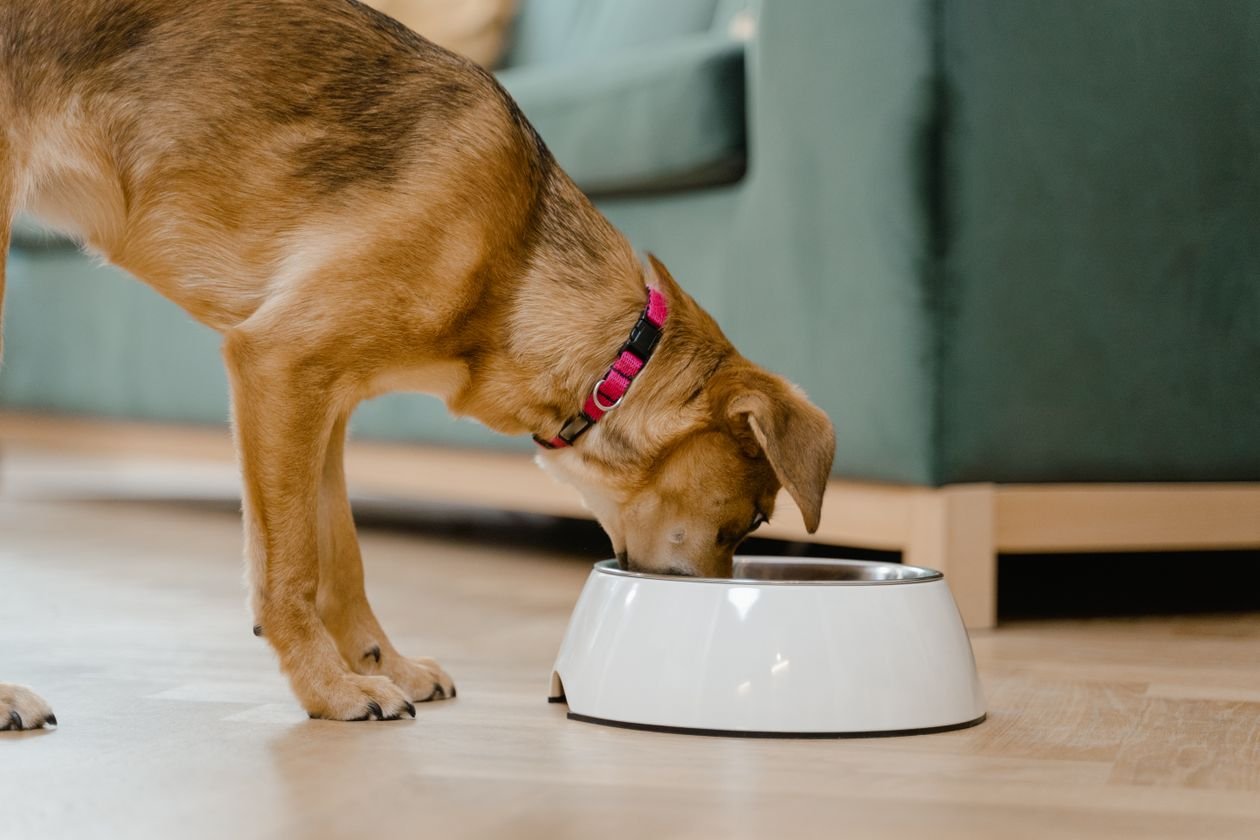
Weighing — the five-minute weekly routine. Weigh once a week, on the same day, at the same time of day, on the same scale. Puppies under about 15 lb can go on a kitchen scale in a basket; above that, weigh yourself holding the puppy on a bathroom scale and subtract your own weight — and weigh yourself first, alone, so the subtraction is honest. Write the number down the same day: the printable puppy weight tracker on this site is a one-page sheet for exactly this, and the growth tracker plots the numbers against age so a puppy drifting off its own curve shows up early. What you are watching for is the trend, not any single reading: a steady climb inside the band is on track, a flat line across two weeks at 4–9 months is worth a vet call, and a sudden drop is a vet visit the same day. Do not weigh daily — day-to-day variation from food, water and a full bladder is larger than a day’s real growth, and daily numbers only create worry.
When to call the vet — the short list. No weight gain for two weeks during the fast-growth months. Weight loss at any age. A puppy below the chart’s bottom band that also fails the ribs test. Vomiting or diarrhoea that lasts more than a day. A swollen belly with retching and no vomit — emergency, go now. Anything on this list beats another week of watching and waiting.
Frequently Asked Questions
How much should a Boxer puppy weigh at 8 weeks?
About 9–20 lb for a male and 7–16 lb for a female, on the reconciled chart in this article — the widest 8-week spread in this series, because the sources disagree about how wide the range is. Petgauge’s narrow WALTHAM-based range is 9.2–11.3 lb for males, while caninecalc publishes 10–20 lb. A puppy anywhere inside the band, gaining steadily and passing the ribs test, is on track; a puppy below the band at two weigh-ins in a row is worth a vet check.
How big will my Boxer puppy get?
Most adult males finish at 65–80 lb and females at 50–65 lb, on the AKC profile — 23–25 in tall for males, 21.5–23.5 in for females. To estimate your own puppy, divide its current weight by the share of adult weight for its age (62% at 6 months, 80% at 9 months, 90% at 12 months): a 45 lb 6-month-old male is heading for about 73 lb. The parents’ weights are the best predictor of all if you know them.
Why does my Boxer puppy look so skinny?
Because Boxers are a late-filling breed. They grow fast for six months, reach full height at 12–14 months, and do not fill out with chest and muscle until 18 months to 2–3 years — so a gangly adolescent is normal, not underfed. Do the ribs-and-waist test: ribs easily felt under a thin fat layer, waist visible from above, belly tucked from the side. If your puppy passes the test, eats well and gains steadily, the skinny look is the breed. If the spine and hip bones are visible, or weight gain has stopped, see the vet.
When do Boxers stop growing?
Height is mostly done by 12–14 months, weight by 15–18 months, and muscle and chest fill continue until 2–3 years. A Boxer is not fully filled out at its first birthday — the year after that is when the adult shape arrives. Weight gained after the frame is done is fat or muscle, not growth, so keep weighing and keep using the ribs test through the second year.
Why do Boxer weight charts disagree so much?
Because no measured Boxer-specific growth curve exists — furlyo says so openly — so every chart is built a different way: WALTHAM curves, percentage-of-adult-weight methods, breeder tables, or size-based models. The modelled curve (puppyweightcalc) runs far below the rest and admits it is unvalidated; one popular chart (iHeartDogs) peaks at 80–90 lb at 12 months, above its own adult range; and even the adult female anchor is disputed (50–65 lb on the AKC profile, 55–70 lb on two rivals). This article’s chart is the union of the four AKC-anchored sources, with the outliers shown beside it rather than hidden inside it.
Sources
- American Kennel Club — Boxer breed page (adult weight: males 65–80 lb, females about 15 lb less; height males 23–25 in, females 21.5–23.5 in): akc.org/dog-breeds/boxer/
- Petgauge — Boxer Puppy Weight Calculator, updated July 2026 (WALTHAM-curve sex-split chart; full adult weight around 15–18 months): petgauge.com/puppy-weight-calculator/boxer/
- Furlyo — Boxer Dog Feeding Chart, updated 11 November 2026 (% of adult weight by age; “no Boxer specific growth curve exists, so the monthly figures are our own estimate”; bloat safety): furlyo.com/t/boxer-dog-feeding-chart/
- Caninecalc — Boxer Weight Chart by Age: Male & Female (2026), updated ~6 November 2026 (sex-split chart; adult males 65–80 lb, females 50–65 lb): caninecalc.com/boxer-weight-chart/
- Dogchart — Boxer Dog Size – Height & Weight Chart (Male vs Female), updated 29 May 2026 (sex-split chart; height done by 12–14 months, muscle fill to 18–24 months; female adult range 55–70 lb noted as the outlier): dogchart.com/boxer-dog-size.html
- iHeartDogs — Boxer Dog Weight by Age 2026: Complete Male and Female Growth Chart, updated ~16 October 2026 (sex-split tables; 12-month male 80–90 lb above its own adult 65–85 lb; fastest growth 4–8 months; filled out by 2–3 years): iheartdogs.com/male-female-boxer-weights-heights-by-age/
- PuppyWeightCalc — Boxer Growth Chart (“not measured breed-specific percentiles”; model “has not yet been validated”): puppyweightcalc.com/breeds/boxer-growth-chart
- American Boxer Club, via breeder sources — fully grown male 65–85 lb, female 50–65 lb (the parent-club reading behind iHeartDogs’ heavier adult anchor).
Internal links in this article: puppy weight calculator · puppy growth tracker · printable weight tracker · puppy feeding calculator · puppy not gaining weight · breed weight and growth hub · puppy weight by age.